Maybelline founder Tom Lyle Williams

Tom Lyle Williams, the founder of Maybelline, owned the estate at 900 Airole Way in Bel Air, California, from 1950 until his death in 1976.


The 8,231-square-foot property, valued at $250,000 in 1961, was a modern glass and steel home built after his previous residence, Villa Valentino, was taken for the Hollywood Freeway. The estate featured a statue called
Aspiration, relocated from the Villa, and hosted family gatherings with relatives like his niece Annette Williams Corbett and siblings Eva and Mabel Williams. After Williams’ death, the property was sold to film director Roman Polanski, then to Lindsey Buckingham of Fleetwood Mac, who remodeled it. It sold for $19.5 million in 2005. The current home, rebuilt in 2002, is a 10,000-square-foot Wallace Neff-style estate with 5 bedrooms, 7 bathrooms, and views from downtown Los Angeles to the ocean.

The estate at 900 Airole Way in Bel Air, California, associated with Maybelline founder Tom Lyle Williams, has a rich history and notable features. Below is a detailed look at the property during Williams' ownership and its evolution:
During Tom Lyle Williams' Ownership (1950–1976)
  • Acquisition and Context: Tom Lyle Williams purchased the property in 1950 after his previous home, Villa Valentino, was acquired by the state for the Hollywood Freeway. The new estate was a modern architectural departure, featuring a glass and steel design, which was innovative for the time.
  • Size and Value: In 1961, the home was recorded as an 8,231-square-foot residence valued at $250,000, reflecting its status as a luxury property in one of Los Angeles' most exclusive neighborhoods.
  • Key Features:
    • Statue of Aspiration: A prominent statue, originally from Villa Valentino, was relocated to the Airole Way estate. It became a centerpiece of the property, symbolizing Williams’ personal and professional ambitions.
    • Gardens and Views: The estate boasted expansive grounds with meticulously maintained gardens, offering sweeping views from downtown Los Angeles to the Pacific Ocean, a hallmark of prime Bel Air real estate.
    • Interior: While specific interior details from Williams’ era are sparse, the glass and steel design suggests an open, light-filled space with modern furnishings, likely tailored to entertain family and industry guests.
  • Role in Family Life: The home served as a gathering place for the Williams family. Tom Lyle hosted relatives, including his niece Annette Williams Corbett, sister-in-law Eva Williams, and sister Mabel Williams. Family events, such as holiday gatherings, were held here, cementing its role as a personal and social hub.
  • Cultural Significance: As the residence of Maybelline’s founder, the home was a backdrop to Williams’ later years, during which he oversaw the growth of his cosmetics empire before selling Maybelline to Plough Inc. in 1967.
Post-Williams Era
  • Subsequent Owners:
    • After Tom Lyle Williams’ death in 1976, the estate was sold to film director Roman Polanski.
    • It later passed to Lindsey Buckingham of Fleetwood Mac, who undertook significant renovations, altering the original glass and steel structure.
  • Modern Transformation:
    • The original home was demolished, and in 2002, a new 10,000-square-foot residence was built on the site, designed in the style of renowned architect Wallace Neff.
    • The current estate features:
      • 5 bedrooms and 7 bathrooms, blending classic elegance with modern amenities.
      • Luxury amenities: A pool, spa, and outdoor entertaining areas with panoramic views from downtown LA to the Pacific Ocean.
      • Architectural details: High ceilings, grand living spaces, and meticulous craftsmanship, typical of Neff-inspired designs.
    • The property sold for $19.5 million in 2005, reflecting its prime location and upgraded features. Recent estimates suggest its value has appreciated significantly, aligning with Bel Air’s high-end real estate market.
Historical and Cultural Notes
  • Bel Air Prestige: The 900 Airole Way address places the estate in one of Los Angeles’ most coveted enclaves, known for its privacy, exclusivity, and proximity to Hollywood’s elite. Neighbors historically included celebrities and industry titans.
  • Maybelline Legacy: The home’s connection to Tom Lyle Williams ties it to the Maybelline story, which began with his creation of mascara in 1915. The estate reflects his success and influence in the cosmetics industry.
  • X Post Insights: Recent posts on X mention the property in the context of Sharrie Williams’ book, The Maybelline Story, noting its significance as Tom Lyle’s residence and its later ownership by Polanski and Buckingham. These posts highlight the estate’s enduring place in Maybelline’s narrative.
Limitations
  • Specific architectural plans or detailed interior descriptions from Williams’ era are not widely documented in public records or recent sources. Most information focuses on the estate’s size, value, and role in family life.
  • The current home, rebuilt in 2002, bears little resemblance to the original structure, making it challenging to reconstruct exact details of the 1950s–1970s design.


Bill Williams, born William Preston Williams Jr. in 1923, was the nephew of Tom Lyle Williams, the founder of Maybelline.


William Preston Williams Jr. Evelyn Frances Williams  Tom Lyle Williams and Emery Shaver 1934, Chicago 

The son of William Preston Williams and Evelyn Frances Williams, Bill grew up deeply connected to the Maybelline family saga. 

After William Preston Williams Sr early death in 1936, Bill spent much of his childhood in California, often at his uncle Tom Lyle’s Villa Valentino in the Hollywood Hills. This lavish estate, purchased from Rudolph Valentino in 1926, became a backdrop for Bill’s early years, surrounded by glamour, custom Packards, and the buzz of the cosmetics empire.

Bill’s passion for cars blossomed there, sparked by rides with Tom Lyle in a 1940 Packard 120 Convertible Victoria down Sunset Boulevard to sign movie-star contracts for Maybelline ads. This love affair with classic cars defined much of his life—he later owned treasures like a 1963 Lincoln Continental and a 1968 Ford Shelby Mustang GT 500, reflecting the Rat Pack swagger he admired. A memorable encounter with Frank Sinatra at Palm Springs airport in 1982 saw Bill sharing champagne from his limo stash, toasting with his idol.

Though not directly involved in Maybelline’s operations, Bill carried the family’s legacy through his charisma and zest for life. 

Married to Pauline Mac Donald and later Gloria Rosan, Bill lived vibrantly until his death in 2006, leaving a legacy of car enthusiasm and Maybelline lore, chronicled by his daughter, Sharrie Williams, in The Maybelline Story. 

 Tom Lyle Williams, the founder of Maybelline, had a close relationship with his nephew, Bill Williams (often referred to as "Billy" or "Bill" in family accounts). Bill was the son of Tom Lyle'sThe son of William Preston Williams and Evelyn Frances Williams, Bill grew up deeply connected his Uncle after his father's early death. Their bond was shaped by family ties, shared experiences, and Bill's exposure to Tom Lyle's glamorous lifestyle, which significantly influenced Bill's interests and personality.

Bill spent much of his childhood visiting and staying with his uncle at the Villa Valentino, Tom Lyle's luxurious Hollywood Hills estate, which was originally owned by silent film star Rudolph Valentino. This time together fostered a deep connection between them. Tom Lyle, a private yet generous man, provided Bill with a window into a world of beauty, wealth, and creativity. Bill developed a lifelong passion for classic cars, particularly convertibles, which was inspired by his uncle's own love for custom-designed vehicles, such as the 1939 Packard 120 Convertible Victoria that Tom Lyle kept at the Villa. Bill's favorite car, a 1977  Clenet.  was a reflection of this influence, and he went on to collect and sell many classic cars throughout his life.

Their relationship was also marked by shared leisure activities. At the Villa Valentino, Tom Lyle and Bill enjoyed swimming in the Olympic-sized pool, playing badminton, and spending time in the Hawaiian-themed game room, where they’d drop dimes into a slot machine. These moments highlight a playful, familial dynamic, with Tom Lyle acting as both a mentor and a fun-loving uncle. Bill’s exposure to this environment, filled with Hollywood glamour and Maybelline’s advertising legacy, left a lasting impression on him.

Tom Lyle’s generosity extended to his family, including Bill. When he sold Maybelline to Plough Inc. in 1967, he ensured that stockholding family members, including Bill’s branch of the family, benefited financially, further cementing his role as a supportive figure. While specific details about their day-to-day interactions are limited, it’s clear that Bill admired his uncle and was shaped by the time they spent together, particularly during his formative years at the Villa Valentino. This relationship blended familial affection with a shared appreciation for beauty, style, and the finer things in life.

Villa Valentino, nestled at 6776 Wedgewood Place in the Hollywood Hills, was a Mediterranean-style estate that became a cornerstone of Tom Lyle Williams’ life and the Maybelline legacy.


Originally built in 1925 by architect Lester G. Scherer for silent film star Rudolph Valentino and his wife, Natacha Rambova. Its stucco walls, tiled roof, and lush landscaping—complete with palm trees, rose gardens, and a stone fountain—evoked Old Hollywood glamour. Valentino lived there briefly before his sudden death in 1926 at age 31, after which the property hit the market.

Tom Lyle Williams, flush with Maybelline’s growing success, bought Villa Valentino in late 1926 or early 1927 for $57,500—about $1 million in today’s dollars. For Tom Lyle, a discreet gay man who avoided the spotlight, the secluded estate offered both privacy and prestige. He moved in with his partner, Emery Shaver, and turned the villa into a personal sanctuary and occasional business hub. The garage housed his prized custom Packards, including a 1939 Packard 120 Convertible Victoria, while the interior—featuring hardwood floors, arched windows, and a grand staircase—hosted family gatherings and quiet retreats. His nephew, Bill Williams, spent significant time there, soaking in the opulence and car culture.

A hidden room, possibly Valentino’s old love nest, doubled as a safe for Maybelline’s secrets. The estate’s commanding views of Los Angeles, from downtown to the ocean, made it a coveted spot, yet Tom Lyle kept it low-key, avoiding the lavish parties typical of Hollywood elite.

The Villa Valentino stands as a testament to Tom Lyle’s quiet empire-building and the Maybelline dynasty’s Hollywood roots.

Emery Shaver was a pivotal figure in the history of the Maybelline Company, serving as the creative and advertising genius

Emery Shaver helped transform it from a small mail-order operation into a global cosmetics powerhouse.

Tom Lyle Williams and Emery Shaver

Emery Shaver, Arnold Anderson and TL Williams 

Born in 1903, Emery met Tom Lyle Williams Sr., Maybelline’s founder, in Chicago during the early 1920s, when both were young men navigating the city’s vibrant commercial scene. Their partnership—both professional and personal—became the backbone of Maybelline’s success, with Emery’s innovative promotional strategies complementing Tom Lyle’s entrepreneurial vision.

Emery joined Maybelline in its nascent years, shortly after Tom Lyle launched the company in 1915 inspired by his sister Mabel’s homemade lash-darkening mixture. By the 1920s, Emery quickly became Tom Lyle’s right-hand man. His talent lay in crafting compelling ad campaigns that tapped into the cultural shifts of the time—particularly the growing independence of women and the glamour of Hollywood.
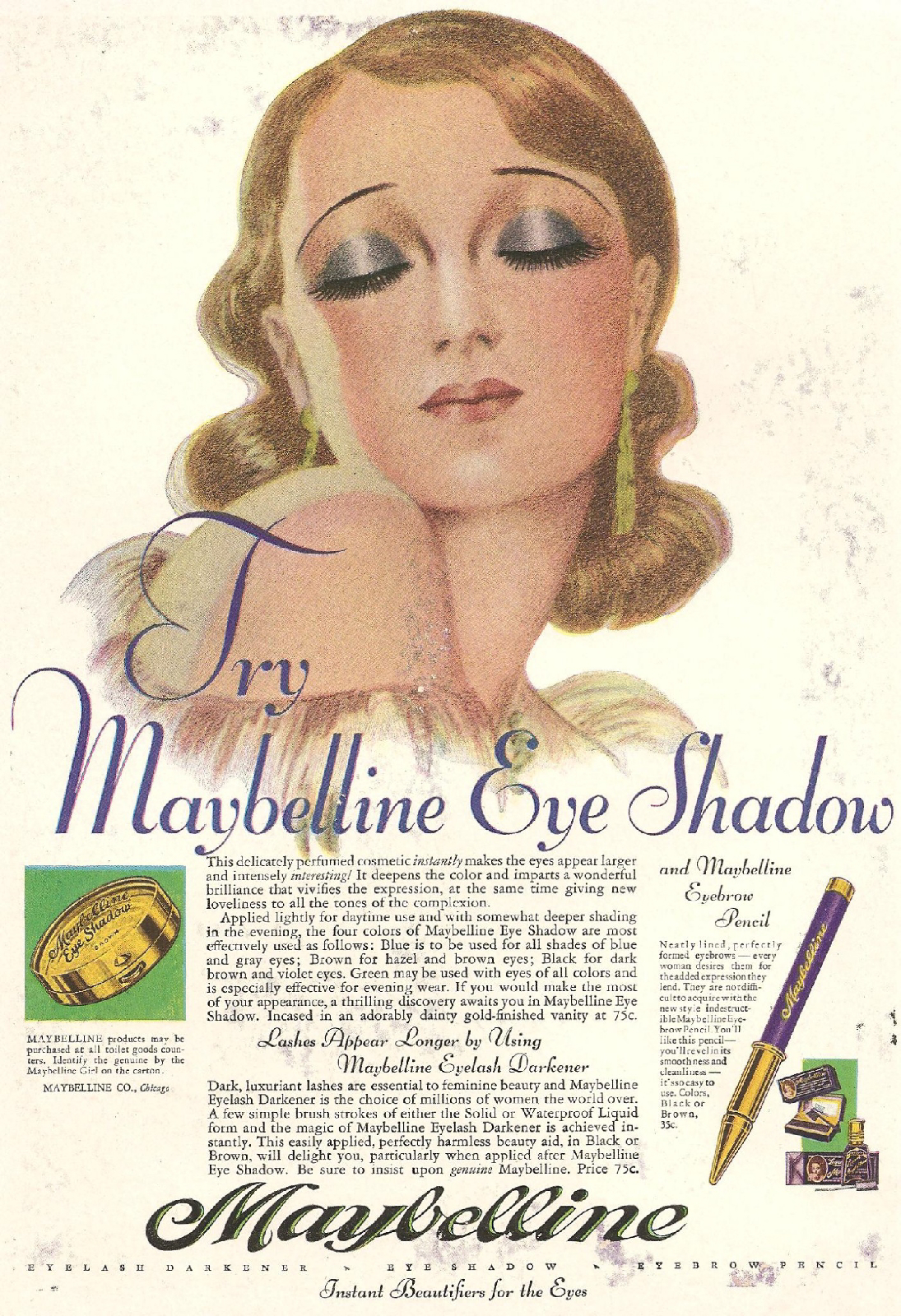
Emery pioneered Maybelline’s iconic print advertisements, featuring endorsements from silent film stars like Ethel Clayton, Gloria Swanson, and Viola Dana. These campaigns, often placed in movie magazines and women’s publications, positioned Maybelline mascara as an affordable luxury, democratizing beauty for the masses.
Beyond advertising, Emery played a key role in product expansion and branding. When Maybelline introduced its first eyelash and eyebrow makeup in cake form in 1917, followed by innovations like the 10-cent mascara tube with a brush in the 1930s, Emery’s flair for promotion ensured these products reached a wide audience. His slogans and visuals—like the famous “Eyes That Charm” campaign—cemented Maybelline’s reputation as a leader in eye cosmetics. He also helped navigate the company through the Great Depression, using radio advertising and drugstore distribution to maintain growth when competitors faltered.
Emery’s influence extended to the company’s operational structure. As Tom Lyle’s partner in both business and life (the two shared a close, lifelong relationship often described discreetly in family accounts due public scrutiny. His strategic input was crucial during the company’s international expansion in the 1940s and 1950s, when Maybelline entered markets in Europe and Latin America. By the time television emerged, Emery adapted again, crafting early TV spots that kept Maybelline ahead of the curve.
His death in 1964 from a heart attack marked a turning point for Maybelline. Tom Lyle, devastated by the loss and nearing his own retirement, sold the company to Plough Inc. in 1967 for $135 million—a decision influenced heavily by Emery’s absence. The sale ended the Williams family’s direct control, though it secured their financial legacy.
In Maybelline’s history, Tom Lyle Williams known as the King of Advertising, and his partner, Emery Shaver, were remembered as the mastermind's behind the brand and market dominance. While Tom Lyle provided the initial spark and business acumen, Emery’s creative brilliance and relentless work ethic helped propel Maybelline into the cultural zeitgeist, making it a household name long before its acquisition by L’Oréal in 1996. His contributions, though sometimes overshadowed by the Williams family narrative, were indispensable to the company’s rise.


Tom Lyle Williams Jr., the only son of Maybelline founder Tom Lyle Williams Sr., played a notable but complex role in the history of the Maybelline Company


Tom Lyle Williams and Tom Lyle Williams Jr 


Shaped by both his familial ties and his personal trajectory. Born in 1912 in Kentucky to Tom Lyle Sr. and his first wife, Bennie Gibbs, Tom Jr. (often referred to as "Cecil" in his early years) grew up during the formative years of Maybelline, which his father established in 1915. While Tom Jr. was not a central figure in the company's day-to-day operations or its creative genesis—unlike his aunt Mabel, who inspired the brand, or his father’s partner Emery Shaver, who drove advertising, or his uncle Noel who gave Tom Lyle the seed money to start Maybelline - he nonetheless became part of its legacy through inheritance and executive involvement.

Tom Jr.’s early life intersected with Maybelline’s rise as his father built the company from a small mail-order business in Chicago into a cosmetics powerhouse. By the 1930s, as Maybelline expanded its product line and global reach, Tom Jr. was a teenager, often captured in family photos alongside his father and grandfather, Thomas Jefferson Williams. His upbringing was influenced by the wealth and prominence Maybelline brought the Williams family, though his parents’ marriage ended in annulment shortly after his birth, leaving him primarily under his mother's care.
As an adult, Tom Jr. assumed a formal role within the Maybelline Company, eventually rising to the position of President at Maybelline Co., Chicago, and General Partner at Williams Investments, a financial arm tied to the family’s business interests. This occurred during the company’s peak years, particularly after World War II, when Maybelline became an international brand. However, his tenure was not marked by the same visionary leadership as his father’s.
Tom Sr., alongside Emery Shaver, had been the driving force behind Maybelline’s innovation and marketing, while Tom Jr.’s role appears to have been more administrative, leveraging his position as heir rather than creator. The company remained headquartered in Chicago until its sale, and Tom Jr. was part of the family ownership structure that profited when Tom Sr. sold Maybelline to Plough Inc. in 1967 for a reported $135 million—a deal prompted partly by Emery’s death in 1964 and Tom Sr.’s subsequent withdrawal from active management.
His death in 1978, at age 66, just two years after his father’s passing in 1976, marked the end of the direct Williams lineage’s involvement with Maybelline, which by then had transitioned into the hands of corporate entities, eventually becoming part of L’Oréal in 1996.
In the broader arc of Maybelline’s history, Tom Lyle Williams Jr. represents both continuity and contrast. He was a beneficiary of the empire his father built—sharing in the wealth and prestige alongside other family members when the company was sold—but his contributions were overshadowed by the foundational work of Tom Lyle Sr, Noel, Mabel, and Emery. His story underscores the personal dynamics within the Williams family, where business success coexisted with private challenges, and highlights how Maybelline’s legacy evolved from a family-driven enterprise to a global brand beyond the Williams name.

Harald Rags Ragland was the only top executive outside the Williams family,

Harold "Rags" Ragland played a pivotal role in transforming Maybelline from a small mail-order business into a major player in the cosmetics industry. Joining the company in 1933 as a marketing executive, he brought professional direction to its sales and promotion efforts during a critical growth period. Ragland shut down the inefficient mail-order operation, streamlining distribution by addressing logistical issues and forging new sales channels through chain and department stores. This shift broadened Maybelline’s reach beyond its original customer base.

One of his key innovations was making the ten-cent "purse size" mascara widely available, tapping into the affordability trend during the Great Depression. He also introduced eye-catching display cards that could be hung prominently in stores, replacing cluttered counter stacks with a more strategic merchandising approach. These cards initially featured the "Maybell Girl" but were updated in 1936 to a modern design, signaling a break from the outdated Maybell Laboratories branding. His efforts significantly boosted visibility and sales.
Ragland’s impact extended to the company’s leadership structure as well.

As the only top executive outside the Williams family, he provided an outsider’s perspective while working closely with founder Tom Lyle Williams and his brother Noel. By 1934, his strategies had strengthened Maybelline’s cash flow enough to allow Tom Lyle to acquire competing mascara businesses, cementing its dominance in the American eye makeup market. Ragland’s marketing savvy and operational overhaul were instrumental in elevating Maybelline from a modest outfit at Ridge and Clark in Chicago to a globally recognized brand

Noel James Williams, Tom Lyle Williams’ older brother, played a pivotal role in the founding and growth of the Maybelline Company.


Noel James and Frances Allen Williams 1916.

In 1915, when Tom Lyle needed startup capital to launch his mail-order cosmetics venture, Noel provided a critical $500 loan—money he’d saved to marry his childhood sweetheart, Frances Allen. This investment kickstarted Maybelline, and Tom Lyle repaid it within a year, allowing Noel and Frances to wed in 1916. In gratitude, Tom Lyle made Noel vice president of the company, a position he held for life.

Noel was the steady hand to Tom Lyle’s visionary flair. Based in Chicago, where Maybelline was headquartered, Noel managed day-to-day operations while Tom Lyle focused on advertising and expansion, often from his Hollywood base after the 1930s. Noel’s role emphasized stability and responsibility—he ran a tight ship, overseeing the company’s logistics and administration. Family was inseparable from the business for him; he lived near the Maybelline warehouse early on and later moved to a suburban executive home as the company grew. His meticulous nature ensured the company’s operational backbone held firm as it scaled into a national success.

By 1935, Noel and Frances had four kids, Helen, Annette Allen and Richard. Balancing
family life with his executive duties. He worked alongside other relatives, like brother-in-law Ches Haines in transportation, keeping Maybelline a family affair. Even as Tom Lyle innovated with movie-star endorsements and new products, Noel’s grounded leadership in Chicago kept the company humming—crucial to its rise as a cosmetics giant before Tom Lyle sold it in 1967. Sharrie Williams, Noel’s great-niece, often highlights his foundational support and quiet strength as key to Maybelline’s enduring legacy