Maybelline founder Tom Lyle Williams

MAYBELLINE HISTORY BY JAMES BENNETT FOR COSMETICS AND SKIN


The rise of Maybelline from a small mail-order firm to a global cosmetics business is impressive. Despite the fact that the company is now called Maybelline New York, its early fortunes, like those of Max Factor and the Westmore Brothers, were tied with the growing motion picture business in California.

Tom Lyle Williams


Cosmetics and sSkin


Known by those close to him as Tom Lyle, the founder of Maybelline was entrepreneurial, hard working, prepared to take advice and loyal to friends and family. His good looks and ability to get on with people were undoubtedly of great assistance. In 1912, aged 16, he moved from Morganfield, Illinois to Chicago and got a job with Montgomery Ward, a long running mail-order catalogue business. After experimenting on his own with a variety of mail-order ventures he left Montgomery Ward in 1914 to concentrate on his own business. By then he had already met and started a long-term relationship with Emery Shaver [1903-1964] who joined him in the venture. The following year he wired his sister Mabel to come to Chicago to help with the business.

Maybell Laboratories


In 1915 Tom Lyle watched his sister Mabel fix her singed eyebrows using a mixture of Vaseline, ash and coal dust, a trick she apparently got from ‘Photoplay’ magazine. Seeing an opportunity for a product to sell through his mail-order business he used a chemistry set to produce a mixture containing petrolatum (Vaseline), carbon black, cottonseed oil, and safflower oil that he hoped he could sell. Unfortunately, when Mabel applied it to her lashes it ran into her eyes and stung them badly.
Undaunted, Tom Lyle sought professional advice and commissioned Parke-Davis, a wholesale drug manufacturer, to make a suitable product for sale. The result was a scented cream consisting of refined white petrolatum along with several oils to add sheen. It did not contain any colouring agent but it seemed to ‘brighten the eyes’ (Williams & Youngs, 2010, p. 22). He called the product ‘Lash-Brow-Ine’, selecting the name partly because of its similarity with other eyelash and eyebrow products already on the market; a decision that would result in difficulties later.
Lash-Brow-Ine was to be packed into small aluminium containers and sold through mail-order in two sizes, at fifty cents and one dollar. Using money he got from his brother Noel to get this new venture off the ground, Tom Lyle acquired product and packaging and placed an advertisement for Lash-Brow-Ine in ‘Photoplay’ in 1916. As cash came in, it was used to place advertisements in other magazines such as the ‘Pictorial Review’, the ‘Deliniator’, and the ‘Saturday Evening Post’ and so the business grew (Williams & Youngs, 2010, p. 25).
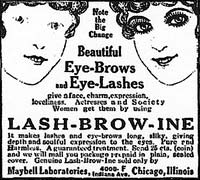
1916 First Lashbrowine
Right: 1916 The first advertisement placed for Lash-Brow-Ine in Photoplay magazine.


Advertising for the Lash-Brow-Ine claimed that it ‘nourished and promoted the growth of eyelashes and eyebrows’. Tom Lyle was canny enough to suggest that you needed to use “two to three small boxes before any marked improvement is noted”, thereby ensuring a number of sales before dissatisfaction might set in. Pamphlet material that came with the product also suggested it could be used to cure baldness. Although we would now consider these claims to be untrue, at the time it was commonly believed that substances like Vaseline, olive oil and lanolin would stimulate hair growth.
How to use “LASH-BROW-INE”
Take a little “LASH-BROW-INE” on the tip of the finger and rub gently over the Brows and Lashes, always rubbing in the direction in which the hair grows. Be sure to rub well into the roots, and then take a soft cloth and wipe around the Brows and Lashes, leaving the “LASH-BROW-INE” only where you wish the hair to grow. To produce the very best results the very tip end of the Lashes should be clipped every two months. The clipping should be done by another person, using small manicure scissors, so as only to clip the tip ends. The Eyebrows should never be clipped.
(Lash-Brow-Ine pamphlet.)
See also: Eyelash Growers
Following the success of Lash-Brow-Ine, Tom Lyle commissioned other products from Parke-Davis including ‘Odor-Ine’ Toilet Lotion (a deodorant), ‘Maybell Coloring’ (an eyebrow and eyelash dye), ‘Lily of the Valley Face Powder’, ‘Maybell Beauty Cream’, rouge and lipstick. None of these additional products produced remarkable sales and were eventually dropped.

Maybelline


In 1917, again with the assistance of Parke-Davis, Maybell Laboratories began production and sale of a cake eyelash and eyebrow beautifier. The exact composition of this product is unknown but it was most likely a sodium stearate based cake mascara known earlier also as ‘water cosmetique’ or ‘mascaro’.
See also: Water Cosmetique
Like other products of its type the colouring agents were suspended in a base of sodium stearate soap. The soap and pigments were mixed together, extruded into strips, stamped and dried. The product was applied by first wetting the block, then using a small brush to lift and apply the colouring to the eyebrows and eyelashes. Early versions could irritate the eye but later versions made with triethanolamine stearate were non-smarting.
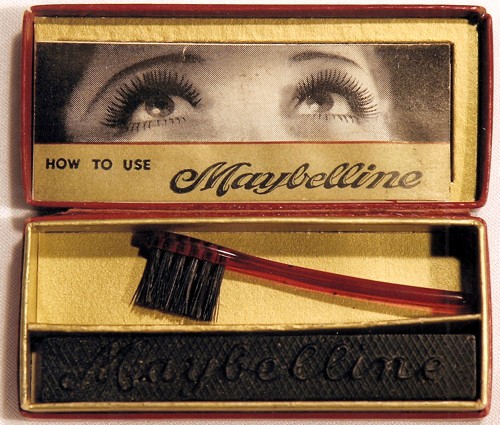
Maybelline block mascara
Above: Maybelline eyelash beautifier with block, brush and instructions in a cardboard box. There is a mirror almost completely hidden behind the instructions. The product form is almost identical to earlier French eye cosmetics.
The new product named ‘Maybelline’ came in two shades, black (containing lampblack) and brown (containing iron oxides) and was sold for seventy-five cents in a small box with a picture of the Maybell Girl on the top. The box included a rectangular block of product stamped with the name Maybelline, a small bristle brush and had a mirror attached to the inside of the lid. It was advertised as being an “ideal, harmless preparation for darkening eyelashes and eyebrows”.
In 1920 Tom Lyle’s decision to use the name Lash-Brow-Ine came back to haunt him. In that year he lost an appeal over a trademark dispute with Benjamin Ansehl of St. Louis, Misssouri. The loss meant that the business could no longer use the name Lash-Brow-Ine and cemented the use of Maybelline in all advertising after that date.
See also: Lash-Brow-Ine
In 1924 the growing business was relocated to larger headquarters in North Ridge Avenue, Chicago. The new headquarters came with a new business name as Maybell Laboratories had been renamed as Maybelline in the previous year.
Growth and development continued for the remainder of the decade. A water-proof liquid version, applied with a paint brush built into the lid, was introduced in 1925 and Maybelline was promoted, in both its solid and water-proof liquid forms, in black and brown colours. In 1929 eyebrow pencils and eye shadow were added to the product line-up. The eyebrow pencils were also sold in black and brown but the eye shadows came in blue, black, brown and green, with violet added the following year.
Promotion continued to play an important role in the success of the company with Maybelline spending over one million dollars on advertising between 1915 and 1929 (Williams & Youngs, 2010, p. 99). A lot of advertising featured actresses including Phyllis Haver, Ethel Clayton, Viola Dana, and Natalie Moorhead. Cross-promotion of this sort was of critical to the success of Maybelline but was also important to the actresses and the movies they appeared in.
Both stage and screen had helped promote the use of eye make-up in the 1920s. The Ballets Russes, who toured the US in 1916 and 1917, demonstrated an exotic glamour that relied, in part, on make-up to accentuate their eyes. In the movies, the vamp look used by actresses such as Theda Bara and Pola Negri created a demand for eye make-up from women who wanted to look like them. Unfortunately, the vamp look was also associated with risqué costumes and suggested a certain looseness of character. This led to an association between eye make-up and immorality, a state of affairs that lasted well into the 1950s.

Mascara


Maybelline introduced eye shadow and eyeliner to their product lines in 1929. This meant that the original Maybelline was now only for eyelashes and it was renamed ‘Maybelline Eyelash Darkener’ and then reformulated in 1931. In 1933 ‘eyelash darkener’ began to be referred to as mascara, a process that was completed by 1935. This was rather late in the day as Helena Rubinstein, Dorothy Gray, Marie Earle and others had been using the term for years. The adoption of mascara by Maybelline may have been to help separate its products from those associated with the ‘Lash Lure’ dye scandal of 1933.
For absolute safety in darkening your lashes use genuine, harmless Maybelline.
Non-smarting, tear-proof Maybelline is NOT a DYE, but a pure and highly refined mascara for instantly darkening and beautifying the eyelashes.
For over sixteen years millions of women have used Maybelline mascara with perfect safety and most gratifying results
(Maybelline advertisement, 1934)
See also: Lash Lure

Respectability and quality


The early 1930s was a difficult time for Maybelline but from adversity came strength. American production of toiletries and cosmetics declined from $193 million in 1929 to $97 million in 1933 and the number of companies almost halved from 815 to 490 (Jones, 2010, p. 109). The companies most at risk were those at the lower, mass-market end, which included Maybelline. As well as the general economic difficulties caused by the depression, eye make-up came under attack because of its associations with flappers and the perceived immorality of the movie industry of the 1920s. Then in 1933 the Lash Lure scandal caused a temporary sales drop in all mascaras.
In 1931, in an attempt to improve sales, Maybelline introduced a ten-cent trial ‘purse size’ that could be ordered through a mail-coupon. This was so successful that it was eventually made available through point of sale outlets as well. Moves were also made to improve sales distribution, particularly outside of the Chicago area, and packaging and display cartons were redesigned to make them more visible.
The use of movie stars remained an important part of the Maybelline advertising strategy but, in the 1930s, endorsements were more sober in tone and there was an increased use of models rather than actresses in the before and after shots. This reflected the position of the motion picture industry which adopted self-censorship in 1934 in the form of the Production Code. In that year Maybelline added radio to its advertising arsenal when ‘The Maybelline Hour’ began broadcasting on WFNT out of Chicago (Williams & Youngs, 2010, p. 134).
Maybelline, along with a number of other mascaras, received favourable reports in the widely read book ‘Skin deep: The truth about beauty aids‘ published in 1934. However, given that the Lash Lure scare of 1933 had hurt sales, Maybelline sought to protect itself from questions regarding the quality of its products by obtaining the ‘Good Housekeeping Seal of Approval’ which was placed prominently in most advertisements for the rest of the decade. Phrases like ‘contains no dye’, ‘absolutely harmless’ and ‘perfect safety’ were also inserted liberally in advertising copy.
Product packaging was also upgraded as part of the drive towards associating Maybelline with quality. Gold metal vanity cases were introduced for the solid mascara and in 1936 a new cream mascara was introduced in dainty zipper bags; the liquid mascara seems to have disappeared from the product line at the same time. These upgrades in products and packaging and the more sober tone in advertising were to make Maybelline products more acceptable to middle America and the department stores in which many of them now made their cosmetic purchases. Given that the 1934 cosmetic survey by ‘Woman’s Home Companion’ did not include eyeshadow, mascara and eye pencil as they were not considered important, anything that fostered sales to middle America would be to the company’s benefit.
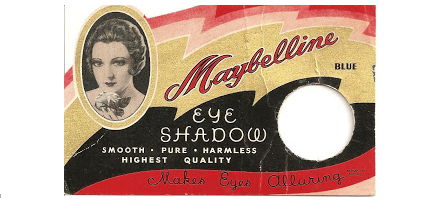
Maybelline CardMaybelline’s fortunes were dramatically improved when Harold Ragland joined the company in 1933 and assumed control of sales and promotion. Under his more professional direction the company closed down the mail-order business, fixed many of its distribution problems and opened up new avenues for sales through chain and department stores. Ragland also made the ten-cent ‘purse size’ more widely available and introduced a new form of display card that could be hung prominently to attract the customer’s attention. The original cards used an image of the Maybell Girl but these were soon replaced thereby closing the last symbolic links with the old Maybell Laboratories.

Above: One of the original display cards introduced by Harold Ragland. The Maybell girl was soon replaced with a more contemporary image. The eye shadow product is missing.
By 1934 the cash flow was strong enough to allow Tom Lyle to start buying up other mascara businesses as they came on the market, thereby solidifying Maybelline‘s dominance in eye make-up in the American market. The 1930s also saw Maybelline expand into Canada and Europe (Williams & Youngs, 2010, p. 260). South America was added after the war and other countries followed giving Maybelline a global reach. At home, although there was increased competition from the majors, figures indicated that Maybelline still had about 75% of the American mascara market in 1947.

Corporatisation and sale


After its incorporation in 1954 the company saw two decades of continuous growth and expansion, with sales reaching $25 million in 1966 (Williams & Young, 2010, p. 304). During this time the company remained firmly fixed on eye products, including mascara, eyeliner, eyeshadow, eyebrow pencils, eyelash curlers and eyebrow tweezers.
In 1958, following Helena Rubinstein’s introduction of ‘Mascara-matic’, Maybelline introduced its own wand mascara with a spiral brush, ‘Magic Mascara’. Also introduced were new self-sharpening eyeliner/eyebrow pencils and stick eye shadow. The new mascara wands would result in the decline of cake and cream forms and in 1963 Maybelline released ‘Ultra-lash’ mascara, followed soon after by ‘Ultra-Brow’, ‘Ultra-Line’, and ‘Ultra-Shadow’.
In 1967 Tom Lyle reached the age of seventy and was ready to sell. After turning down bids by Revlon and Schick he sold the company to Plough for just over $130 million in stock. The business remained named Maybelline through the merger of Plough with Scherling and the sale of Maybelline to the Wasserstein Perella investor group but it was renamed ‘Maybelline New York’ in 2001 by its current owners L’Oréal, USA.

Timeline


1915Maybell Laboratories founded to make Lash-Brow-Ine.
1916Advertising in Photoplay magazine begins.
1917First real model used in advertising.
1917Maybelline Cake eyelash and eyebrow make-up released.
1923Maybell Laboratories renamed Maybelline.
1924Maybelline moves to new headquarters in North Ridge Avenue Chicago.
1925Waterproof Liquid Maybelline eye make-up introduced.
1929Eyebrow Pencils (black and brown) and Eyeshadow(blue, black, brown and green) introduced into the product line.
1930Violet colour added to eyeshadows.
1931Maybelline introduces new formulation for cake eyelash darkener.
193210-cent mascara created for drug and variety stores.
1933Maybelline begins to be sold direct to stores outside of the Chicago area. Mail-order began to be closed down.
1933First use of the word mascara in Maybelline advertising.
1934Blue colour added to mascara.
1934The Maybelline Hour radio show starts on WFNT Chicago.
1936Cream mascara in a waterproof zipper case released.
1951Emerald Green mascara introduced.
1951First TV advertising by Maybelline.
1954Maybelline incorporated.
1955Antiwrinkle Eye Cream introduced (withdrawn the following year).
1957Self sharpening eyebrow and eyeliner pencil introduced.
1958Magic Mascara with a spiral brush introduced.
1961Fluid Eye Liner introduced.
1963Ultra-Lash released, followed soon after by Ultra-Brow,Ultra-Line, and Ultra-Shadow.
1967Natural Hair Lashes introduced.
1967Maybelline acquired by Plough.
1971Great Lash, a water-based mascara, is introduced to replace Ultra Lash.
1983Shine Free Oil Control make-up line featuring non-comedogenic formulas introduced.
1990Maybelline acquired by Wasserstein Perella & Co.
1991“Maybe she’s born with it. Maybe it’s Maybelline” advertising tagline created.
1996Maybelline acquired by L’Oréal USA.
2001Maybelline becomes Maybelline New York.

Sources

Jones, G. (2010). Beauty imagined: A history of the global beauty industry. Oxford: Oxford University Press.
deNavarre, M. G. (1941). The chemistry and manufacture of cosmetics. Boston: D Van Nostrand Company.
Phillips, M. C. (1934). Skin deep: The truth about beauty aids. New York: Garden City Publishing.
Poucher, W. A. (1932). Perfumes, cosmetics and soaps, Vols. 1-2(4th ed.). London: Chapman and Hall.
Sharrie Williams. (2011, September). Retrieved September 3, 2011, from http://www.maybellinebook.com/
Williams, S. & Youngs, B. (2010). The Maybelline story and the spirited family dynasty behind it. Florida: Bettie Youngs Books Publishing.

Copyright © 2013 James Bennett  

REVIEW.....Maybelline Story reads like the best fiction but with real characters and plots that take us on an American dream wild ride.
From the Midwest through Chicago and Hollywood, we follow a path strewn with scandals, jealousies, triangles and betrayals. Throw in arson, a still-unsolved murder and even the Feds and Mafia and you have an exciting and bumpy journey that leaves more than one casualty in its wake. And Maybelline was along for the ride. 


The characters seem larger-than-life yet somehow remain vulnerable and sympathetic This is a family that continually grasped at the shiny ring only to discover that it might be no more than their own reflections staring back, sometimes accusingly, in the mirror. 

The legacy is in good hands with Ms. Williams. She's a true storyteller and writes with passion and candor while bluntly sharing her own resolve to rise above her 

family's lifelong mantra of money, beauty and the search for perfection. It's a critical but tender tale of redemption that displays an understanding, compassion and love for her family. She never gave up on her dream to tell this story and literally braved fire and fury to share it with the world. It's a book that you really can't put down, a true page-turner and I couldn't wait to find out what happened next. 


You'll never look at a Maybelline ad again without feeling a tug of empathy for these characters and the struggles and determination of one man's effort to capture beauty on a brush and change forever the color palette of the world.      Amazon.com

Maybelline's Master of Perfection.


Armed with market savvy, an eye for beauty and a penchant for perfection, Tom Lyle continued to experiment boldly, introducing what would become one of the most familiar and effective ploys in advertising: “before and after” imagery. This captured the imagination of women everywhere, creating a need that he filled by placing striking cosmetic displays in dime and drug stores across America. Soon the name Maybelline came to represent more than just mascara—it meant beauty, sex appeal and self-confidence, indispensible tools for every woman’s success—however she defined it.

REVIEW...Maybelline deeply impacted everything from legendary Hollywood movie stars to every day working people's lives throughout so many generations. A


  Sharrie Williams, author of the Maybelline Story has written a really wonderful book!  Its an amazing story of once upon a time in America, where great desire, ambition and dreams overcome great adversity and obstacles. There is spirit, triumph mixed with tragedy as a company grows from nothing to world prominence in its industry. Written in an engaging, personal way so that as you read it, you are drawn in, and feel like you are right there with the family.

       Maybelline (both the products and the story) interacted and evolved through the major cultural and  dynamic historic events in American history and deeply it impacted everything from legendary Hollywood movie stars to every day working people's lives throughout so many generations. And there is an eternal verity that comes through as a constant theme: when you make a woman feel beautiful, there is a profound effect on everyone around her. 


        You tell the story in a compelling way that makes it come alive, and also creates new stories that grow naturally from the main one."


Larry Crandell, Santa Barbara California.


Maybelline Heir, Bill Williams 1977 Clenet # 13 is ready for its close up

CLENET TV .....click to see the original clip of 1977, Series 1 Clenet owners. 


After a year and half, Bill Williams, 1977 Clenet, seemed to glow as it sped out of storage, excited to be filmed for a new Documentary.


  Friday was a long day for  # 13's original fabricator,
Steve Kouracos and my sister Donna and me.   We were all interviewed for a Documentary, asking the question... "Why are Clenet owners still so passionate about their car after  35 years."


Alain Clenet's, neo-classic product of the Clenet Coachworks of Santa Barbara, Calif., was meant to be America's answer to the Rolls-Royce.  Some of the original owners included, Rod Stewart, Wayne Newton and Ken Norton.  The rock group Kiss wanted theirs in shocking pink but were turned down. My father, Bill Williams bought #13 for $28,000 and added some custom features including his initials painted on both doors and Gatsby etched glass. for more information about the Alain Clenet and his Car click here.

  I will post more as the producer sends snippets to me.

Happy Saint Patricks Day, May the wind always be at your back.

Sharrie Williams will be Presenting The Maybelline Story, March 15 in Newport Beach California.


Buy a signed copy of The Maybelline Story  order with PAYPAL NOW


I'm very pleased to be Presenting The Maybelline Story, for "Contacts of Orange County," March 15, at The Pacific Club in Newport Beach California.   The Networking  Group is made up of professional and entrepreneurial women who are leaders in their field of endeavor.  Member expertise spans the arts, law, business and finance, all levels of education, community activism, intercultural exchanges, healthcare, electoral politics, publishing, and real estate.  This group also is dedicated to finding balance in life and always gives back to our communities.

Click on bottom right hand box for full screen.

Take a glance at the fascinating topics featured in my book

Order your signed copy of The Maybelline Story with 

PAYPAL NOW


Maybelline, Cosmetics,  Great Lash Mascara, beauty, Chicago, Hollywood, Morganfield KY, Tom Lyle Williams, L’Oreal, Great Depression, Bix Beiderbecke, Marketing Strategist, History, Family Dynasty, Mabel Williams, Noel J. Williams, Preston Williams, Evelyn Williams, Eva Williams, Chester Haines, Chet Hewes


Nickelodeon, Mary Pickford, Sears Roebuck and Co, Popular Mechanics Magazine, The Mayflower Families, Mercy Hospital, Mail Order Catalogues, The Household Guest, Weeghman Park, Balaban and Katz Theatre, Charlie Chaplin, The Little Tramp, World War 1, Cecil B. DeMille, Rudolph Valentino, Boston Opera Company, Jazz-Bo, Erte’, Art Nouveau, Harry Houdini,


 The Lusitania, Lillian Gish, Birth of a Nation, Photoplay magazine, Vaseline, Victorian Era, Marshall Fields and Co., Park-Davis, Mascaro, Police Gazette, Saturday Evening Post, Gibson Girl, Coco Chanel, Powder, Rouge, Wall Street Journal, Lost Generation, Lord and Taylor, The Jazz Age, Louis Armstrong, Al Capone, Flappers, Chicago Institute of Music, Theda Bara,


 Miss America Pageant, Lake Zurich, Scabs, Cleveland, Pinkerton Agents, Mildred Davis, Jack Dempsey, Gene Tunney, Cubs Park, Wrigley Field, Mayo Clinic, Charlie Chase, Viola Dana, Lefty Flynn, Beverly Hills Hotel, The Polo Lounge, Tom Mix, Miss Mixit, Will Rogers, Clara Bow, Mildred Davis, Gloria Swanson, Malibu Colony, Wings the film, 

The Jazz Singer, Argentina, gangsters, St Valentines Day Massacre, Herbert Hoover, Academy of Motion Picture Arts, Douglas Fairbanks, Roosevelt Hotel, The Circus (film), Marion Davies, Roaring Twenties, Art Deco, Ponds Cold Cream, Helena Rubenstein, Duke University, Actress Natalie Moorhead, Actress Norma Shearer,


Eastman-Kodak Camera, Tarzan of the Apes, Amos and Andy, “The Little Engine That Could,”  Jimmy Shield, William “Bill” Haines, MGM Studios, Baby Face Nelson, John Dillinger, Pretty Boy Floyd, Clyde Barrow, Bonnie Parker, The New Deal, The San Francisco Golden Gate Bridge,


 Adolf Hitler, Tower Hill Military School, Dundee Illinois, Jean Harlow, Bombshell, National Recovery Act, FDR, The Maybelline Hour, WFNT, Penthouse Serenade,


 Good Housekeeping Seal of Approval, Dust Bowl, Biograph Theatre, Biograph Studio, Lady In Red, Joan Crawford, Technicolor Film, 1934 Packard Automobile, The 1934 Worlds Fair, Jake the Barber, William Randolph Hearst,


 Marion Davies, Vogue Magazine, Ladies Home Journal, Max Factor, Charles Revlon, Merle Norman Cosmetics, Production Code Administration, (PCA), Hays Code, Cary Grant, Randolph Scott, California, Marlene Dietrich actress, Lilly Dache’, Carmen Miranda, Laguna Beach, The Great Ziegfeld, Deanna Durban actress, Judy Garland,


 Biltmore Hotel,  Musso and Franks restaurant, Hedy Lamaar actress, Carole Lombard actress, True Confession Magazine, World War 11, Eleanor Fisher actress, Santa Anita Racetrack,
 Clark Gable, Spencer Tracy, Bing Crosby, Seabiscuit,


 Benny Goodman band leader, Alice Faye actress, Alexander’s Ragtime Band, Fox Studio, The Fleishmann Hour, Times Square, Merle Oberon actress, Glenn Miller bandleader, The Wizard of Oz, Gone With The Wind, King Kong, Bill “Bojangles” Robinson, Eleanor Powell actress, Tommy Dorsey,


 Jimmy Dorsey bandleader, Tommy Dorsey bandleader, Frank Sinatra, Winston Churchhill, Tony Martin, Daryl Zanuck, Betty Grable, Phil Harris, Shirley Temple, Jane Withers, Busby Berkeley, Gene Krupa drummer,
 Cedric Gibbons, Douglas Aircraft, Louie B. Mayer, Mickey Rooney, Jeanette MacDonald, Glamour magazine, Ronald Reagan, Combat Camera, Bette Davis, Hollywood USO, Rita Hayworth , Mocambo restaurant, Xavier Cugat, Desi Arnaz, Greer Garson actress, Edgar Cayce, Jitterbugging, The Palladium, Romanoff’s restaurant, Humphrey Bogart, Lana Turner, The Coast Guard, Elyse Knox pinup girl, Linda Darnell, Maria Montez Susan Hayward, Virginia Mayo, Barbara Stanwyck, Fort Riley, Fort Ord, Philippines, General Douglas MacAuthur, Lois Collier actress, Ava Gardner,


 The American Dream, Norma Christopher, 1947 Tournament of Roses, Carlyle Blackwell Jr. Photography Studio, Hess Photography, Monoplies, McCarthyism, Bel Air Fire, Baldwin Hills Flood, Tungsten, Adlai Stevenson, President Eisenhower, Walkie Talkie Dolls, Dorian Gray, Chinatown in LA, Olvera St in LA, Frederick’s of Hollywood, Rosie the Riveter, James Dean, Bill Haley and the Comets, Elvis Presley, Chuck Berry Maybellene the song, Grace Kelly, Prince Rainier 111 of Monaco,


 Marilyn Monroe, Hanna-Barbera Productions, Ben Hur, Camarillo State Mental Hospital, Manic-Depressive disorder, F.W.Woolworth, Patricia Stevens Modeling School, Dream Girl, The Gong Show, The Dating Game, Plough Inc, Schering-Plough,  Martin Luther King Jr, Robert Kennedy, The Vietnam War, Neil Armstrong, Balboa Bay Club Newport Beach CA, Conway Twitty, Arson Fire In Hot Springs AK.

REVIEW.....Anyone interested in the fashion world and the power of artifice will absolutely relish each and every chapter, to the very tumultuous end of the story.


Buy a signed copy from author Sharrie Williams - Order your from 
PAYPAL NOW


A great story about the beautiful mortals.....A Compelling True Story of Success and Intrigue.....

I was only casually acquainted with the glamorous woman at the center of this saga. I was 22 years old in Hot Springs, Arkansas, and she was a brilliant but oddly vulnerable creature on the outer boundaries of my life then. This book answers so many questions I have had about her for many years. I am so glad it exists, and even more glad that it was written in a dynamic and thrilling style. The man who may be partially responsible for her death has been aptly described by the author. This book captures the legend that surrounded the woman and her family, and it is a great page-turner.   More importantly, the shining character of the remarkable Tom Lyle Williams guides this book.  By Holly

Marketing guru saw expansion potential for Maybelline in 1930s


Buy a signed copy of The Maybelline Story

 Order your copy from PAYPAL NOW


Maybelline's best kept secret was Rags Ragland Sr.

Let me introduce myself.  I am Alan 'Rags' Ragland the youngest and closest son to the 'Rags', who you undoubtedly will be coming to know in THE MAYBELLINE STORY.  Rags was the marketing guru who saw the expansion potential of this lonely little company at the corner of Ridge and Clark in Chicago.

I am so delighted that Sharrie Williams and Bettie Youngs have brought this silent story to you.  This has been a dream of Sharrie’s and I started talking to her about the inner workings of  Maybelline an estimated eighteen years ago. I am probably the last inside person left, that is able to reflect this fascinating and unbelievable success story.  Dad/Rags, was the only top executive outside of the Williams family.  Most of the reflections are from him and my exposure to these remarkable people.  Hence, hopefully, this will be another perspective of the scenario that is helpful in filling in the total picture of The Maybelline Story.


The effectual buyout of the Maybelline company was now $132.3M!

Alan A. Ragland and Sharrie Williams
Order a signed copy of The Maybelline Story with  PAYPAL 

Excerpted from a letter from 
Alan A. Ragland.  Ragland also wrote the preface for The Maybelline Story 

The Maybelline Company was acquired by Plough, Inc. effective 2/28/68.  Negotiations were currently going on with American Cyanamid, Revlon, and Kimberly Clark.  Rags Ragland, The Marketing genius Tom Lyle hired in in 1933, had owned Plough stock and was the unique influence in recommending Plough as a suitor to the Maybelline Co.  Ragland's reasoning was that he knew that Plough was in a solid enough position to buy the Maybelline and also due to the leverage factor, he knew that Plough would be a preferred candidate.  Plough was in a far superior leveraged condition in that the company had much fewer shares outstanding.

During the 11th hour of negotiations, Ragland suggested to Tom Lyle's son Tom Jr., that Maybelline include Plough in the bidding:  Tom's initial reaction was "Rags, they do not have the money"... Ragland's response was, "Yes, they do Tom. I know their circumstances, as I have been a stockholder for years and know they are cash heavy."  Tom called Abe Plough and the next day

Plough was quickly and shrewdly chosen as the suitor:  They offered a minimum of  $100M  and there was a period of grace, whereupon the stock would float, then a specific day, which was 2/28/68 that the Plough stock price would be "pegged" for the official exchange.  On 2/28/68 the price of Plough had rallied so dramatically that the effectual buyout of the Maybelline company was now $132.3M!  Yes, it was leverage that caused this!  Demand plus fewer shares caused a stock breakout, which is a scenario seen on Wall Street each day.

In 1973 Schering, the 2nd largest pharmaceutical company in the world and Plough merged.  Each of the stockholder's received 1.32 shares of Schering for every share of of Plough that they had owned. 


Abe Plough and Lanny Smith flew up with their executive staff in their private jet from Memphis to talk to Maybelline in Chicago ... post haste!


many lessons you will learn about ethical and creative smart business practice.


Buy a signed copy of The Maybelline Story

Order your copy from PAYPAL NOW


Not only was the marketing behind Maybelline brilliant, the handling of the business as a whole was ingenious.  If you own a business or are starting a business pick up a copy of "The Maybelline Story And The Spirited Family Dynasty Behind It,"  for the many lessons you will learn about ethical and creative smart business practice.  


Through the 53 year history when Tom Lyle Williams and his brother Noel James Williams were at the helm, Maybelline weathered and overcame some disastrous times in this country and the world. And it never folded. One of Tom Lyle's secrets was he surrounded himself with educated, brilliant people, like Rags Ragland, a marketing genius who helped shoot Maybelline to the moon with his innovation and inventive thinking. 


 And when the government considered Maybelline a monopoly and threatened to destroy the company, Tom Lyle divided Maybelline within the family, turning the production of mascara over to his brother in law, Chet Hewes and the transporting of Maybelline over to his brother in law Ches Haines.....to keep it a private, family-owned business.....  


Read all about the ups and downs of the Maybelline Company and the family behind it. 


Buy a signed copy from author Sharrie Williams today.


ULTRA BIG ULTRA LASH UPDATE FOR ALL THOSE WISHING TO HAVE IT BACK..

I finally found the Ultra Big Ultra Lash Mascara on Ebay and paid $29.99 for it. It is the ONLY mascara that keeps my lashes curled and soft. Maybelline Great Lash is awful, I makes lashes hard and brittle and does not keep the curl! I called Maybelline after receiving my Ultra Big Ultra Lash because my lashes now look like they did when I was 25 because of this mascara. WHY did Maybelline discontinue??? WHY?? PLEASE bring it back! It's selling for $50.00 to $75.00 per tube on the Internet! PLEASE! Pamela. MAYBELLINE ULTRA BIG ULTRA LASH MASCARA


Helen Tanguay February 19, 2013 6:20 pm I agree with all lovers of this mascara. I have used it as well, since my teen years and never had need to give it up till it was sadly discontinued. It was the best ever mascara of all time for me. Went on perfectly with no globs or clumps...smoothly, evenly, naturally and it kept the curl. It lengthened beautifully as well. I received so many compliments way back when, on my eyelashes. The brush was the best design ever. I HATE those big fat brushes out there that don't allow any control whatsoever. I have never been happy with any mascara since, (and I have been searching for over 20 years. PLEASE bring it back! on MAYBELLINE ULTRA BIG ULTRA LASH MASCARA


I was more than disappointed when I was unable to find this mascara. I was just telling my 3 daughters this morning, on the way to school and they were apply mascara, talking about their new mascaras. Yes, they all use something different and have their favorites. Well be the stay at home mom with no makeup on, yet, I had to chime in on the fact that there's not a mascara in the world that could touch UBUL! I have used it since I started wearing makeup and when they stopped making it, I went to every store buying up all they had. For over 10 years now I have tried every brand and every brands type! Still to this day 1/20/2013 NO SUCCESS! Now the girls are like "mom, try to see if they have repackaged it under a different name, you know Google it". So I did and came across this site. PLEASE tell me they will bring this back or sell the recipe for it to a brand that will! Robin Pierce, Atlanta GA onMAYBELLINE ULTRA BIG ULTRA LASH MASCARA


I truly feel as if your email today was heaven sent! Unfortunately, they are out of stock at the moment and I am anxiously waiting their reply. Thank you so much for taking the time to refer their website to me. PS - just came home from shopping and the fresh peaches were on sail. I am going to try your Aunt Mabel's recipe for peach cobbler. I saw a video link for you actually making it and it looked delish! You made my day twice today, thank you.


I'm thinking of doing a poll here on the Maybelline Book Blog to see if enough people would like me to petition Maybelline New York to bring back "Ultra Big Ultra Lash Mascara"  leave me a comment below if you want it back.

Here are the winners of my Facebook Contest!!!

FACEBOOK....
Christina Barber of Ottumwam IA

TWITTER.....

Amy Howard of Pavilion NY (@tarportelsis)

Thank you so much for taking the time to LIKE me on Facebook Ladies, your copy of The Maybelline Story, will be in the mail this week.  Congratulations!!!


Vintage 1960s Maybelline print ad slideshow

If my makeup bag ever dumped out of my school locker, slipped down bleachers during Football games, or slid under car seat at the drive-in….I quickly scrambled for my  mascara, because Ultra-Lash was clearly the key to my enchanting doe-eyed sex appeal.


A woman’s expressive eyes can say “Come look at me.”  “Coax me out of my bashfulness.”  “Yes, I’m flirting.”  “I’m interested in you.” 
 My great uncle, Tom Lyle Williams, appreciated beauty in all women and their beauty spoke to him straight through their eyes.  Here is a tribute to Maybelline during the 1960s.


IN THE BEGINNING THERE WAS MAYBELLINE...a never-before-told story that spans a 100 years and paints the picture of the American Dream.


   My Great uncle Tom Lyle Williams founded The Maybelline Company, in 1915 and owned it until it sold to Plough Inc. in 1967.
   Here is a peek at The Maybelline Story from the 1920's...

                          In the Beginning there was MAYBELLINE....


Noel James and Frances Williams 1917.

But it wouldn't have been possible without.....

Noel J. Williams.